
Dairy Goats and Goat Milk: Learn the Basics

Learn the Basics of Dairy Goats and Goat Milk so you can begin your home dairy! Interesting Note: DAIRY GOATS are the #1 MILKING ANIMALS IN THE WORLD!
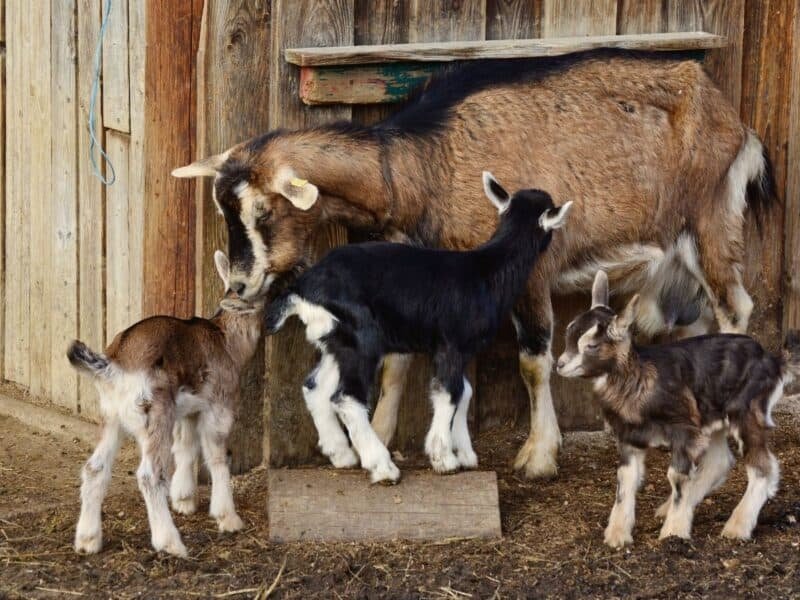
Ivy, the goat on the right with the long ears, is a registered Nubian. Quincy is on the left, and she is a cross between a Nubian and French Alpine goat. Both these breeds are fantastic milk producers.
Further Reading: Nubian and French Alpine
Dairy Goats and Goat Milk

There are several things to think about before getting dairy goats…yes, goats…you should get at least 2 goats!! Goats are a herd animal.
Goats need companionship to stay happy and healthy!!!
Please review the following:
When considering the basics, goats will need some form of shelter, good clean water, plenty of hay and/or pasture, and some type of grain.
- Your goats will need some form of shelter from the elements, especially from rain, wind, and snowy weather.
- Fencing is very important as goats are escape artists and can get out of the best of pens, so make sure to think about secure fencing.
- Stanchion and a few milking items such as a Stainless Steel Milk Bucket with Lid 14 Qt Dairy Pail, ‘Stainless Steel Mason Jar Milk Strainer for Dairy Goats & Sheep,’ and Replacement Filters for Mini Milk Strainer
- Mineral block like a Himalayan Salt Block Lick with Minerals
- Parasite control if this is a problem in your area {there are some good herbal wormers that help with parasites}, such as Herbal Wormer Immunity Builder.
You May Also Find Helpful:
- Top 7 Homestead Planning Tips for Beginners
- Best Egg Laying Chickens & What They Have to Offer
- TIPS for CLEANING YOUR CHICKEN COOP
- Chicken Coop Ideas for Raising the Best Chickens & Eggs
- More on Homestead Life
Getting Started:
First, goat needs are very basic, but they are real needs. Good, clean water is a must for all animals, but it is extremely important for dairy animals.
Make sure water is fresh, clean, and easily attainable. If you live in a cold climate with harsh freezing winters, then you must address the winter water availability.
There are many different types of water heaters that can be used during the winter months, but make sure to plan for this with a 5 Gallon Heated Flat Back Bucket.
Feed:
A good quality hay or pasture is the next thing on the list. If you are raising your goats for milk, then you will need to consider providing a high-quality alfalfa hay.
Dairy goats produce milk that contains lots of calcium. In order for your goats to produce milk, they need good quality feed and some grain.
We have used certified alfalfa hay for our goats as well as provided some pasture to keep them busy and healthy. Alfalfa contains calcium!! So, alfalfa hay is very desirable.
Next, consider that a grain mix like C.O.B. Corn, Oats, and Barley, 3-Way feed, with molasses, is highly recommended for your milking nannies.
All goats love 3-Way feed with molasses, but your milkers really need the additional nutritional boost from this grain mix.
This type of 3-way feed is available at your local feed store. Several feed companies are now offering organic grains for livestock.
Feeding grain at milking time is a great way to keep the nannies content while you are milking.
We have used a bucket at the head end of the stanchion for feeding grain during milking.
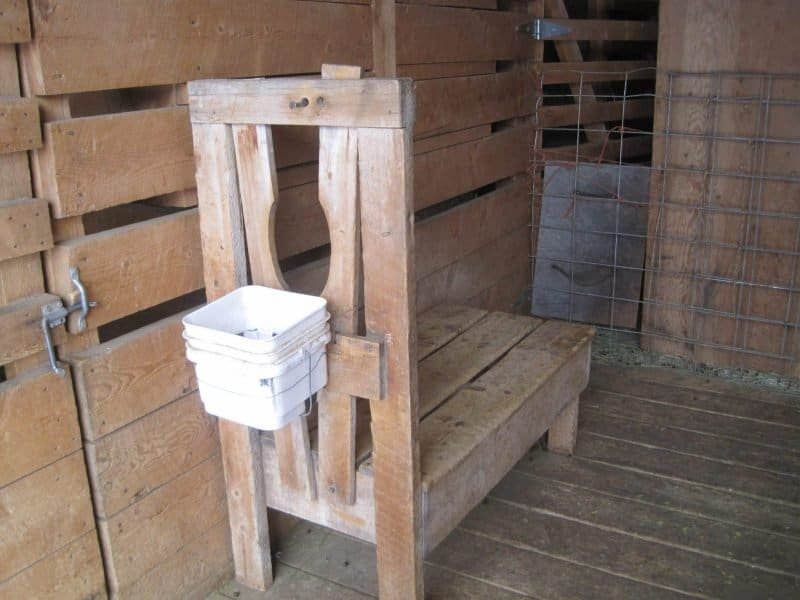
The above style of stanchion has a head catch with a locking bolt on it. The head-catch board pivots to hold the nanny comfortably while she is milked.
This type of stand has worked well for us for many years. The nanny goat learns that she will receive her grain once she enters the head catch.
It might take a few tries to get her to settle down, but once she understands the routine, milking time is enjoyable for her.
Plus, as her milk develops, she is ready to be milked and will be eager to jump on the stanchion!
Shelter:
Next, your goats will need some type of basic protection from the sun, wind, rain, snow, and predators.
They do not need anything elaborate, but they do need something safe and secure. We have a barn that has worked out very well.
The goats are locked in at night to protect them from the elements. Putting the goats in the barn also offered protection from predators such as coyotes, dogs, wolves, bears, etc. Beware of dogs.
Dogs can destroy your goat herd in no time flat. It is an expensive loss and very sad.
Your goats do not need any additional heat except at kidding time for the newborn kids, but they need to be protected from the wind and weather year-round.
Whether it is protection from the hot sun, wind, rain, or snow. Sensibility is important.
Basically, your barn, shed, or shelter needs to have strong walls that will keep the elements and predators out, especially at night.
One of my readers asked about separating out the kids from the nannies at milking time.
This is my reply, but I thought the question was so important that I wanted to include how we milked only once a day instead of milking twice and having to bottle feed the kids.
“Hi Susan… Great question!!! What we have done, so we can “share” the milk with the goat kids and still have some for our family, is separate out the babies from the nannies at night.
This way the nannies produced enough milk for us each morning. After milking, we would then let the goat kids out to be with their moms all day.
The kids were hungry in the morning, but they were able to eat and play all day long! So, we only did one milking each morning, and the kids would be with the nannies the rest of the day.
We would then put the goat kids in a safe stall in our barn at night to sleep. They will be a little noisy at first but then settle down for the night.
This system actually gave the nannies a break so they could get a good night’s rest, too. The nannies were then ready to be milked in the morning prior to letting the kids out to eat and play!!!
By sharing the milk with the kids this way, we did not have to deal with baby bottles and hand-feeding.
But, as always, watch your nannies’ and kids’ health to determine what works best for you and them. Thanks for asking…”.

Fencing:
Protecting your Dairy Goats……… The next topic is fencing…goats are escape artists, to say the least!
We have used hog panels, which have worked out well. Wooden slats also work well to keep goats in.
So your fencing basically needs to have sturdy metal T-posts or wooden posts to which the wire hog panels, horse fence, and wooden slats are attached.
Goats need room, so make your enclosure as large as possible. You can also stake your goat out on a tether, but make sure the area is safe and free of predators.
Milking Area:
The milking area must be kept clean. It is so important to keep everything as clean as possible when handling raw milk.
Here is another view of our stanchion:

Our boys would sweep up before milking each morning to keep the milking area clean. Once the goats were milked, they were let outside into the small pasture that is adjacent to our barn.
At this point, we came into the house to strain the milk. We have a stainless steel milking pail and a small strainer.
It is vitally important to strain your fresh milk prior to putting it in the chill.
We would use small milk filters to strain our fresh milk, and then here is the big secret to delicious-tasting goat milk:.
Here is an excellent information source: Storey’s Guide to Raising Dairy Goats.

At first, the goat milk had an “off taste” when I chilled it in the refrigerator after straining.
I thought I just didn’t like goat’s milk, but after talking to my friends Cecil and Avis, I learned a trick for better-tasting goat milk: Sharp Chill!
To make sharp cheese, strain the milk into Ball Jars and freeze them without lids.
This allows the milk to cool quickly and “breathe,” which helps reduce the “goaty” taste. The milk becomes delicious—definitely give this technique a try!
I learned this from experienced goat owners, and it really works!
By the way, we used to pasteurize our cow’s milk, but later we stopped pasteurizing the goat’s milk because heating it loses too many enzymes.
In Conclusion:
Owning dairy goats is a wonderful way to have wholesome, fresh milk!
With proper planning, they are a fantastic addition to your backyard farm, homestead, farmstead or sustainable living.
Need Help with Planning on Your Homestead or Backyard Projects? Take a look at:
The Backyard Homestead Seasonal Planner:

BENEFITS OF OUR GLASS DAZEY BUTTER CHURN
Find it Only at Lehman’s! Long revered as the … [More]
For further reading and fun try:
Holistic Goat Care: A Comprehensive Guide to Raising Healthy Animals or
The Dairy Goat Handbook: For Backyard, Homestead, and Small Farm
A Little Stuffed Animal Goat or A Large Goat Friend
Also consider making: Goat Milk Soap with this Perfect Goat Milk Soap Recipe


I have had meat goats before and loved raising them but I don’t eat goat. So I am going for Nigerian Dwarfs this time.. getting everything prepared including going through and taking out all the cacti. I’m in Hill Country Texas or will be fixing Florida’s property right now. When I get back I’m pretty good with the health and all what I’m confused on is I don’t need a lot of milk. So when Freshen them, do I bottle feed the kids in the morning and milk the does then let the kids have the does rest of the day? Or opposite?
Hi Susan….great question!!! What we have done, so we can “share” the milk with the goat kids and still have some for our family, is separate out the babies from the nannies at night. This way the nannies produced enough milk for us each morning. After milking, we would then let the goat kids out to be with their moms. The kids were hungry in the morning but they were able to eat and play all day long! So, we only did one milking each morning and the kids would be with the nannies the rest of the day. We would then put the goat kids in a safe stall in our barn at night to sleep. They will be a little noisy at first, but then settle down for the night. This system actually gave the nannies a break so they could get a good night’s rest, too. The nannies were then ready to be milked each morning prior to letting the kids out. By turning the kids out with their moms, we did not have to deal with baby bottles and hand-feeding which worked out great for us. But, as always, watch your nannies and kids’ health to determine what works best for you and them. Thanks for asking., nipples
Looking for advice on any easier ways to break up caked up straw under deep litter (other than hacking – bad wrist). Has anyone used a Rototiller? If so; front vs rear tined.
We have used both. You may try renting the tillers from a local tool rental place before buying one. See which one you like best. Front-tine are usually lighter weight and take less space to store. But, please note that they tend to bounce around more especially if your soil is hard and compacted and/or rocky. Rear-tine are typically more expensive but are definitely nicer! Make sure to try out a rear-tine model. They do take more room to store. But, they take less effort to till the ground. Let us know how things go for you!
Love the article on the goat’s milk. How do you separate your cream so you can make butter? Do you have any fancy tricks?
Hi Brenda….thanks, I am so glad that you enjoyed the information on Goat’s Milk. Goat milk has very little cream that rises to the surface differing from cow’s milk. Goat Milk is naturally homogenized which means the cream is naturally mixed in with the rest of the milk. I have not made butter with our goat’s milk but in doing a quick search on Pinterest there are some great articles available there. Hope that helps!
I have a question about milk and how to handle it. Does each milking have to be kept in it’s own separate jar? If I quick chip a batch today can I mix a quick chilled batch from the next day?
It is best to keep each milking in it own separate jar. Depending on how much milk you get each day, keep quart size jars on hand as well as half gallon and gallon jars. Put the freshest milk in the back of your fridge and rotate your supply. Hope that helps!
How long do you keep the milk in the freezer for the sharp chill before you move to the fridge?
Depending on the size of your jar, try for approximately one hour. Just make sure not to forget the milk, as if it is left in the freezer it will break the jar!